BON GROUP · Real estate in Poznań
You have found a house near Poznań online. Quiet street, garden, and the price seems right. Then you open a forum and read scary posts: foreigners are not allowed, you need permission from practically a minister, and without it the transaction will be cancelled.
It sounds frightening. In practice, everything comes down to two questions: what your residence status is and what exactly you are buying. We explain who needs a permit to buy, how to choose between an existing house and a plot to build on, how much houses around Poznań cost and what to check before paying a deposit.
A permit for a house or a plot is a procedure, not a ban. A foreigner can buy an apartment without any permit at all, and for a house with land there are exemptions and a clear administrative route through the Ministry of the Interior and Administration (MSWiA).
Does a foreigner need a permit for a house or a plot?
The general rule is this: a foreigner needs a permit (zezwolenie) from the Minister of the Interior and Administration (MSWiA) to buy property in Poland. This follows from the Act on the Acquisition of Real Estate by Foreigners (ustawa z 24.03.1920 r.).
Now for the exceptions, and there are quite a few.
- Citizens of EEA countries (the whole European Union plus Norway, Iceland and Liechtenstein) and Switzerland do not need a permit at all, for any property.
- An apartment, known in Polish law as a self-contained residential unit (samodzielny lokal mieszkalny), can be bought without a permit by any foreigner, whatever passport they hold. We cover this in detail in our guide on buying an apartment in Poznań.
- A house with a plot, or land, requires a permit for citizens of Belarus, Ukraine, Russia and other countries outside the EEA, unless an exemption applies.
- The first exemption: the person has lived in Poland for at least 5 years since obtaining a permanent residence permit (pobyt stały) or long-term EU resident status (rezydent długoterminowy UE). In that case, property can be bought without a permit (with certain reservations, see below).
- The second exemption: the foreigner is married to a Polish citizen, has lived in Poland for at least 2 years since obtaining a permanent residence permit (pobyt stały) or long-term EU resident status, and the purchase goes into the spouses' joint property.
There is a nuance that often decides everything. One half of a semi-detached house (bliźniak) or a section of a terraced house (szeregowiec) may be legally designated not as a separate house with land, but as a self-contained residential unit (samodzielny lokal mieszkalny) separated within a building (this is allowed by the Act on Ownership of Premises, ustawa o własności lokali). Such a property is bought under the same rules as an apartment: without a permit, by any foreigner. What a given house actually is can be seen in the land and mortgage register (księga wieczysta), and that is the first thing we check.
A common case: one spouse has citizenship or the right to buy without a permit, and the other does not. If you buy into joint property, both spouses' eligibility is checked. In practice, the issue is often solved with a marital agreement on separation of property (rozdzielność majątkowa): the spouses' property becomes separate, and the house is registered in the name of the spouse who can buy without a permit. The alternative is for the other spouse to obtain a permit. Which works out better in your particular situation is something we calculate before the transaction.
The exemptions have limits: they do not apply in the border zone (strefa nadgraniczna) or to agricultural land over 1 ha. This reservation does not concern citizens of EEA countries and Switzerland; their rule is different. Poznań and its surroundings are not in the border zone, so for the suburbs the first point is usually not an obstacle.
As for agricultural land over 1 ha: a permit will be needed all the same. And plots classed as rolna, that is agricultural land, are additionally regulated by a separate act on the agricultural system, which has its own rules. We check the plot's status before the deposit, so you do not go looking at a house on land that cannot be bought.
The key point: a permit is an administrative procedure, not a ban. The application is submitted to the Ministry of the Interior and Administration (MSWiA). Exact timelines and the fee depend on the specific case, and we check them at the time of submitting. For your own living needs, the permit is issued for a plot of up to 0.5 ha, which for a house with a garden is usually enough.
House and plot: why it is one transaction
Under Polish law, a building is considered part of the land: this is stated directly in the Civil Code (Kodeks cywilny, art. 48). A component part cannot be a separate object of ownership, so you do not buy a house 'separately': you buy the plot together with the house, in one transaction.
There is an exception to this rule: perpetual usufruct (użytkowanie wieczyste). There, the building can belong to the usufructuary while the land itself belongs to the State Treasury or the municipality (gmina). This is not a reason to walk away from a purchase, but it is a reason to read the documents carefully. What exactly is happening with the land is visible in the land and mortgage register (księga wieczysta), and we check it before the deposit.
A second point: not every plot is equally good for building. Budowlana means designated for construction, rolna means agricultural, and the latter, as we wrote above, has its own rules and restrictions. The seller may call a plot 'for a house', but the legal status is checked in the documents, not in the advert.
Buy a plot and build a house yourself: what to consider
The second route to your own house near Poznań is to buy a plot and build. For a foreigner, the permit rules here are the same as described above: land is also property.
After that, everything depends on the land's status. You can build on a plot classed as budowlana, and what exactly may be built is shown by the local development plan (MPZP) or the building conditions decision (WZ). We look at these documents before buying the plot, not after.
The construction itself starts not with the foundations but with the paperwork: it requires either a building permit (pozwolenie na budowę) or a notification (zgłoszenie). Which of the two applies in your case is checked in advance under the current rules.
A separate budget line: utilities. Electricity, water, gas and sewerage are connected through an application to the network operator, which issues the connection conditions (warunki przyłączenia). If there are no mains in the street, connecting can take a long time and cost a lot, and in some locations a septic tank is installed instead of mains sewerage. We check internet coverage in advance too, with the providers. All of this is established before the purchase: a 'cheap' plot with no utilities can easily end up costing as much as an expensive one in the final budget.
'Dachas' and allotment gardens are a separate topic: they have their own specifics, and we are preparing a separate article about them.
What kind of houses are sold here
Listings around Poznań are dominated by three main types of houses:
- dom wolnostojący, a detached house: the plot is yours on every side. Maximum privacy and the highest price.
- bliźniak, a semi-detached house: one wall is shared with the neighbours, but both the price and the plot are more modest.
- szeregowiec, a terraced house, one unit in a row: the most affordable version of 'your own entrance and your own garden'.
Floor areas and plot sizes vary a great deal even within one type; we look at them in specific listings. For a family moving from an apartment, a semi-detached house (bliźniak) or a small detached house is often the happy medium: you get a garden without paying for extra square metres.
Where to look near Poznań and what it costs
The main choice of houses and plots is concentrated not in the city itself but in the municipalities around it. There is even a dedicated Polish portal, bliskopoznania.pl. People look for houses and plots in the municipalities of Czerwonak, Suchy Las, Rokietnica, Tarnowo Podgórne, Dopiewo, Komorniki, Mosina and Kórnik. They lie in different directions, to the north, west or south, and each municipality has its own character and its own prices.
Now, the money. According to listings on the Otodom portal at the end of August 2026:
- Poznań County (powiat poznański), that is the outskirts: realistic house prices start at roughly 500 000 zł, with the listing average around 1.0–1.1 million zł;
- the average price per m² on the outskirts: around 8 000 zł;
- the average size of a house in the county: around 132 m²;
- the city of Poznań: the average house price is around 1.8–1.9 million zł, about 8 900 zł per m².
These are asking prices from listings, before negotiation. The ratio, however, is clear: a house near Poznań is on average noticeably cheaper than one in the city.
Prices below half a million do come up: as a rule, these are houses in need of major renovation or with a very small floor area.
Looking for a house or a plot near Poznań?
Tell us what you are looking for: we will shortlist options, check the documents and see the transaction through in your language.
Contact usWhat to check before the deposit
Here is what we check before handing over a deposit:
- Księga wieczysta, the land and mortgage register. It has 4 sections: description of the property, ownership, rights and encumbrances, and mortgages. On the resale market, checking the register (KW) is a must: it protects you from the previous owners' debts.
- MPZP or WZ. MPZP is the local development plan, WZ stands for building conditions. They show what can be built on the plot and what will be built next door. Bought a house by a field, and two years later a road runs through it? You can see that in the plan in advance.
- Plot boundaries. The actual fence and the boundaries in the documents do not always match. A discrepancy should come to light before the transaction, not in court with a neighbour.
- Utilities. Electricity, water, sewerage, gas: what is connected and what is at the buyer's expense.
- Technical condition. Roof, foundations, damp in the basement. A house from the 1980s and a house from 2020 live by different rules.
And the key difference between two words that are often confused. Zadatek, a deposit: if the transaction falls through and the buyer is at fault, it is forfeited; if the seller is at fault, the seller must return double the amount. Zaliczka, advance payment: if the transaction falls through, it is simply returned. Before signing a document containing one of these words, make sure you know which of the two it is.
How much the transaction costs on top of the price of the house
The price in the listing is not the final one. The following costs are added to it:
- PCC 2% on the resale market: the buyer pays the tax. On the primary market, that is from the developer, no PCC is paid; VAT is already included in the price.
- The notarial fee: on a sliding scale, the more expensive the property, the lower the percentage. We calculate the exact amount before the deposit (zadatek) is paid.
- Court fee of 200 zł for entering a natural person as the owner in the land and mortgage register (księga wieczysta).
And a word about the relief. Since 31.08.2023, buying a first home on the resale market is exempt from PCC, and the relief expressly covers a single-family house (budynek mieszkalny jednorodzinny), not only an apartment. Condition: the buyer (a natural person) must not have owned a home before. Exception: a share of up to 50% received by inheritance does not affect the relief.
The tax itself causes little trouble when you buy a house: the transaction takes place at a notary's, and the notary usually collects and remits the PCC. The rule of filing a PCC-3 declaration within 14 days does exist, but it applies to transactions without a notary and, as a rule, does not affect someone buying a house.
The full cost of the transaction, with taxes and fees, should be calculated before the deposit is paid. This is a basic rule that saves both money and stress.
How the purchase works: from selection to keys
The process is standard, and the steps are as follows:
- Selecting properties and viewings.
- Checking the documents, including the land and mortgage register, the local development plan and the status of the plot.
- Umowa przedwstępna, the preliminary agreement, with a deposit (zadatek) or an advance payment (zaliczka).
- If you are taking out a mortgage: the application to the bank and waiting for the decision.
- The notarial deed (akt notarialny). In Poland a notary is required by law for a property transaction.
- Formalities after the transaction: the tax (usually handled by the notary), entering the new owner in the land and mortgage register, handover of the keys.
The timing between the steps depends on the bank, the notary and the particular transaction; there is no universal figure here.
In Poland a house is sold together with the land in a single transaction, and the rare exception (perpetual usufruct, użytkowanie wieczyste) is visible in the documents. That is why your residence status, the type of plot and the land and mortgage register are checked before the deposit is paid, not after.
Tell us what kind of house or plot you are looking for
We will shortlist options, check every document and see the transaction through in your language.
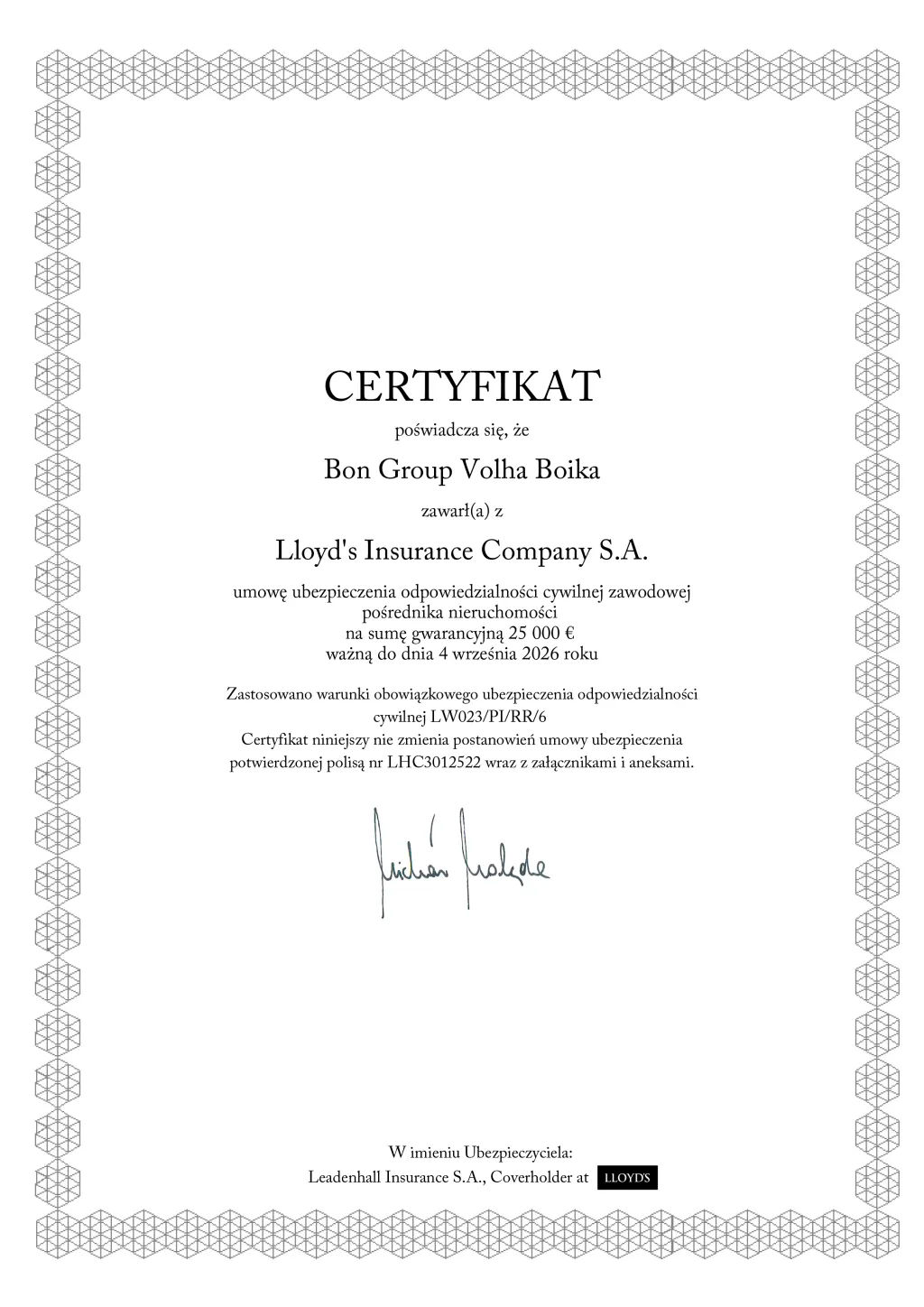
Our real estate agency is insured
Frequently asked questions

Article by Olga Boika, real estate agent at BON GROUP. The material has been checked by the editorial team. Generative tools may have been used in preparing the text and illustrations. The images are for information purposes.